


Quality & Analytics -
Why detection is crucial for peptides
In the case of peptides as research reagents, quality is not an abstract concept, but a measurable and documented property.
Analytical evidence creates transparency about what is actually being investigated and forms the basis for reproducible results.
Without clear analytics, tests can neither be reliably compared nor correctly interpreted.
- Identity and composition must be traceable
- Purity directly influences measurement results
- By-products can distort effects
- Analytics creates comparability between batches
- Documents support responsible handling
- Evidence is part of good scientific practice
In the case of peptides as research reagents, quality is not an abstract concept, but a measurable and documented property.
Analytical evidence creates transparency about what is actually being investigated and forms the basis for reproducible results.
Without clear analytics, tests can neither be reliably compared nor correctly interpreted.
What does "purity" really mean for peptides?
The term purity is often used in a shortened form, but in practice it describes several aspects at the same time. It refers not only to the proportion of the desired sequence, but also to the ratio of by-products, residues and modified variants. This differentiation is crucial for the interpretation of results.
- Sequence purity: Proportion of the correct amino acid sequence in the total material.
- By-products: Incompletely synthesized or concatenated fragments may be present.
- Modifications: Oxidations or deamidations change properties unnoticed.
- Residual substances: Solvents, protective groups or reagents influence measurements.
- Analytical method: The measured purity value depends on the technique used.
A purity value must therefore always be considered in the context of the analytics used. A realistic picture of the actual quality of a peptide only emerges in combination with other evidence.
Certificate of Analysis (COA): Content, significance and limits
The Certificate of Analysis is one of the central documents for the quality assessment of peptides. It summarizes the most important analytical results of a specific batch and makes it possible to check properties in a comprehensible manner. A COA serves as a reference, but does not replace an independent evaluation of the data.

- Batch reference: A COA is only ever valid for a specific production batch.
- Identity information: Contains sequence, molecular weight and basic characteristics.
- Purity value: Indicates the analytically determined proportion of the target sequence.
- Method information: Describes the analysis used to determine the values.
- Tolerances: Measurement results are subject to method-related fluctuations.
- Limits: Not every COA detects all possible contaminants.
A COA should always be considered in conjunction with other analysis data. This is the only way to assess the significance of the reported values for the respective experiment.
HPLC: Separation method, interpretation and typical errors
High-performance liquid chromatography is one of the most important methods for assessing the purity of peptides. It separates components of a sample based on their interactions with the stationary phase and provides a chromatographic profile that allows conclusions to be drawn about composition and quality.
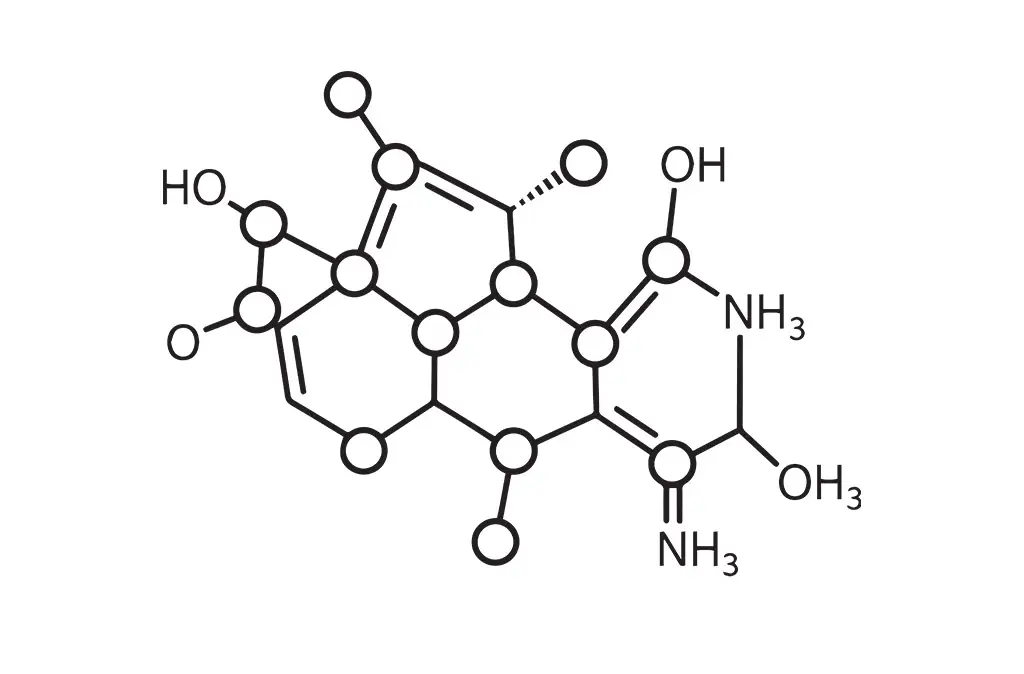
- Separation principle: Different retention times indicate different components.
- Peak interpretation: The area of the peaks is used to estimate the purity.
- Choice of method: Column type, eluent and gradient influence the result.
- Detection: UV or other detectors determine which substances are visible.
- Comparability: Only identical methods provide comparable chromatograms.
- Sources of error: Overlapping peaks or unsuitable methods can overestimate purity.
A single HPLC value should therefore never be considered in isolation. Only the combination with other analyses enables a well-founded quality assessment.
Mass spectrometry (MS): Identity detection and sequence confirmation
Mass spectrometry is primarily used to confirm the identity of a peptide. It measures the mass of the molecules and thus enables comparison with the theoretical molecular weight of the target sequence. Deviations provide indications of modifications or by-products.
Compared to HPLC, MS focuses less on separation and more on clear assignment. By detecting characteristic masses, it is possible to check whether the desired sequence is actually present.
Here too, the significance depends on the method selected and the sample preparation. MS complements other analytical methods and completes the overall picture of the quality of a peptide.
Safety data sheet (SDS): purpose, mandatory information and responsibility
The safety data sheet is a central document for the responsible handling of peptides in the laboratory. It is not used to evaluate efficacy, but provides information on hazards, protective measures and proper handling. For research reagents, the SDS is an essential part of the safety and compliance documentation.

- Information on possible hazardous properties
- Notes on safe handling and storage
- Recommended protective measures in the laboratory
- Information on disposal and environmental protection
- Transport and labeling instructions
- Provision in understandable language for the user
An SDS helps to minimize risks and comply with laboratory standards. It is part of the responsibility of suppliers and users to know this information and take it into account in their day-to-day work.
Batches, traceability and comparability
- Each batch has its own analytical profile
- Batch numbers enable clear assignment of documents
- Traceability is a prerequisite for reproducible results
- Comparability between experiments requires the same batch basis
- Process changes can measurably influence properties
- Documentation combines production, analysis and application
- Long-term studies benefit from consistent batch management
- Transparent labeling reduces interpretation errors
Typical quality problems and how to detect them analytically

- Unexpected peaks in the HPLC chromatogram indicate by-products
- Deviating molecular masses in the MS indicate modifications or degradation
- Broad or superimposed peaks complicate the purity assessment
- Differences between batches are reflected in changed profiles
- Residues from the synthesis influence analytical results
- Improper storage leads to measurable loss of quality
- Incomplete documentation makes root cause analysis difficult
- Methodological differences can distort results
Classifying analytics correctly:
What documents can do - and what they can't
Analytical documents provide structured information on the identity, purity and safety of peptides. They form the basis for well-founded decisions in the laboratory, but do not replace the professional evaluation by the user. Every analysis is bound to methods, measurement conditions and defined questions.
Values from COA, HPLC or MS are snapshots of a batch. They provide information about the tested condition, not about every possible change during storage or use. It is therefore important to understand analytics as a guide and to interpret results in the respective experimental context.
A realistic classification of the documents prevents false expectations. Analysis creates transparency and comparability, but requires that methods are understood and limits accepted. Only this interaction enables responsible and scientifically sound handling of peptides.